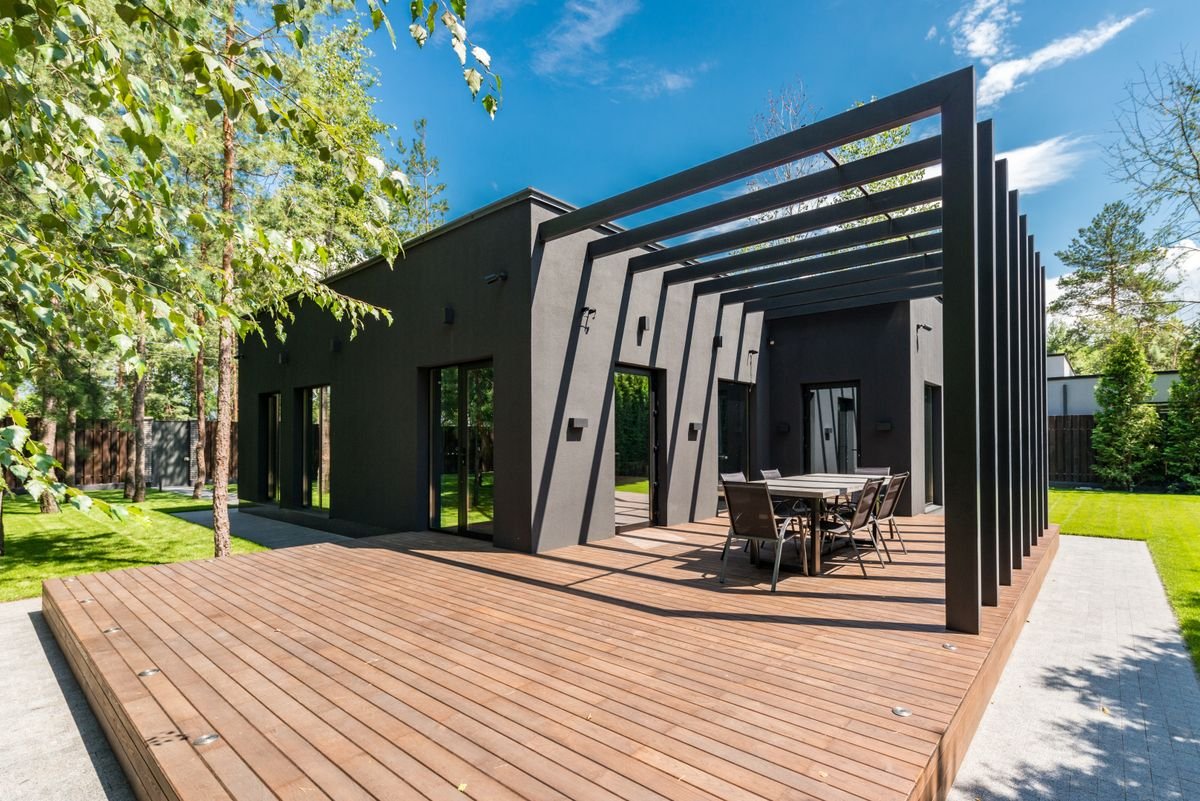
A new deck averaged $8,318 in 2026, with most professional jobs between $4,340 and $12,653. But the number that should decide the material is not on any quote: a wood deck recoups 94.9% at resale and a composite deck recoups 88.5%.
That is the best return of almost any renovation — better than a kitchen, better than a bathroom, better than windows. It is also the opposite of what most decking sales conversations imply, because composite is the upsell and wood is the one that wins on paper.
The 2026 numbers
| Measure | 2026 figure |
|---|---|
| National average, new deck | $8,318 |
| Typical professional range | $4,340 – $12,653 |
| Labour share of total | ~38% |
| Labour rate | $15 – $35 per sq ft |
| Framing labour | $9 – $12 per sq ft |
| Stairs | $25 – $50 per step |
| Permit | $230 – $500 |
If the deck would sit at ground level anyway, price a concrete patio before you commit — no framing, no footings, no railing, and it typically lands well under half the cost of a comparable deck. We break the numbers down in concrete patio cost in 2026.
Cost by decking material
| Material | Cost per sq ft | Upkeep |
|---|---|---|
| Pressure-treated wood | $2 – $5 (material) | Re-stain or seal every 2–3 years |
| Cedar | $3 – $7 (material) | Same, but rots more slowly |
| Ipe and tropical hardwood | $10 – $20 (material) | Oil annually or let it grey |
| Redwood | $5 – $35 (material) | Seal periodically |
| Composite | $12 – $22 material, $25 – $54 installed | Wash it |
Read the composite row carefully, because it is the one people misjudge. Material at $12–$22 and installed at $25–$54 means the boards are roughly half the installed cost — the rest is framing, fasteners and labour, and those are the same whatever you walk on. So the real premium for composite over pressure-treated is not “four times the price”; it is more like 1.5 to 2 times the finished job.
Structurally, pressure-treated framing lasts 40+ years according to the USDA Forest Products Laboratory. The part that wears out on a wood deck is the walking surface and the finish, not the bones. That matters, because it means a wood deck is a thing you maintain, and a composite deck is a thing you buy once — and both of those are legitimate choices depending on whether you would rather spend a weekend or a lump sum.
Cost by deck size
| Size | Area | Installed cost |
|---|---|---|
| 12 × 12 | 144 sq ft | $5,760 – $8,640 |
| 12 × 16 | 192 sq ft | $5,400 – $10,800 |
| 16 × 20 | 320 sq ft | $12,800 – $19,200 |
| 20 × 20 | 400 sq ft | $16,000 – $24,000 |
Cost does not scale purely with area. A 12×12 has the same permit, the same ledger attachment, the same footing inspection and the same set-up as a 16×20, spread across less than half the square footage. That is why the small deck looks expensive per square foot and the big one looks cheap.
Practical consequence: if you are torn between 12×12 and 12×16, the extra 48 square feet is usually the cheapest square footage in the project — you are already paying for everything that makes it a deck. Where the price genuinely jumps is height. Anything more than about a metre off the ground needs a guardrail, deeper footings and often stairs with a landing, and those are three separate line items.
Wood or composite: the honest comparison
| Wood deck | Composite deck | |
|---|---|---|
| National average job | $18,263 | $25,096 |
| Recouped at resale | 94.9% | 88.5% |
| Value added | ~$17,332 | ~$22,210 |
| Out of pocket after sale | ~$931 | ~$2,886 |
| Warranty / life | Structure 40+ yrs, surface refinished every 10–15 | 25–50 yr warranty by tier |
| Ongoing work | Clean and re-seal every 2–3 years | Wash it |
On resale arithmetic alone, wood wins twice: it costs less and it returns a higher share. A wood deck at 94.9% is effectively the cheapest square footage you can add to a house — cheaper, proportionally, than a garage conversion at about 80%.
The case for composite is not financial and it should not be sold as though it is. It is that you never sand, never stain, and never spend a spring weekend on your knees with a brush. Over twenty years that is perhaps seven or eight refinishing cycles you have bought your way out of. If you value that at a few hundred dollars a cycle plus the weekend, composite closes most of the gap — and if you would have skipped the maintenance anyway, composite is the honest choice, because a neglected wood deck does not recoup 94.9% of anything.
One thing to know before you commit: dark composite boards get genuinely hot in direct sun, considerably hotter than wood. On a south-facing deck that people walk on barefoot, that is not a small detail.
What is not in the per-square-foot number
- Railings — required above about 30 inches, and the single biggest add-on. Wood is cheapest, composite matches the deck, and cable or glass runs several times either.
- Stairs — $25–$50 per step, plus a landing if the run is long. Multiple short flights cost more than one long one.
- Footings — depth is set by your frost line, not by the deck. A cold-climate footing is a much bigger hole than a warm-climate one, and it is dug by hand if a machine cannot reach the yard.
- Ledger flashing — where the deck attaches to the house. Done badly, this is the single most common cause of both deck collapses and rot inside the wall. It is not a place to accept the cheap version.
- Permit and inspection — $230–$500. Almost always required for an attached deck.
- Site access — a back garden reachable only through the house is a real labour surcharge.
- Demolition of the old deck — commonly $5–$15 per sq ft, rarely in the headline quote.
Of that list, the ledger is the one to ask about by name. Ask how the ledger is attached, whether it is flashed, and whether it is bolted or screwed. A contractor who answers immediately and specifically is one who has thought about the part of the deck that can hurt someone.
Fencing is the other line people assume is included and is not. If the deck opens onto an unfenced yard, budget that separately — see fence installation cost in 2026 for per-foot ranges by material.
How to read a deck quote
- Is the railing in the price, and in what material? The most common way a deck quote comes in low.
- What size and spacing are the joists? 16-inch spacing feels solid underfoot; 24-inch is legal in places and bouncy everywhere.
- How is the ledger attached and flashed?
- How deep are the footings, and does that meet local frost depth?
- Hidden fasteners or face screws? Hidden clips look better and cost more; on composite they are usually worth it.
- Who pulls the permit and books the inspection?
- Is demolition and disposal of the existing deck included?
The bottom line
Budget $8,318 for an average deck and $4,340–$12,653 as the realistic professional range. Size up rather than down if you are close to a decision — the marginal square footage is the cheapest in the job.
Choose wood if you will actually maintain it, because at 94.9% recouped it is one of the best-returning things you can build. Choose composite if you know you will not, because the maintenance is the whole assumption behind that number.
And spend the money on the parts you cannot see later — footings, joists, ledger and flashing. The boards can be replaced in a weekend in fifteen years. The frame cannot.
If a deck is one of several exterior jobs on your list, our siding replacement costs and window replacement breakdown cover the other two, and the financing options are compared here.
If the deck is going in around water rather than beside it, the numbers change substantially — see inground pool costs in 2026.
Working out your own number? Our free renovation cost calculator gives you the range for your size and area in about ten seconds.