A roof is the one renovation nobody chooses. It arrives as a stain on a bedroom ceiling, or a neighbour mentioning that your shingles look “curly” from the street, and suddenly you are collecting quotes for a job you had not budgeted for. The numbers that come back are wide enough to be unhelpful: one contractor says $9,000, another says $24,000, and both are looking at the same house.
The spread is real, and it is explainable. Below is what the money actually goes to, what the same roof costs in different materials, and the handful of line items that quietly separate a fair quote from a bad one.
What a roof replacement costs in 2026
For a standard single-storey home with a simple gable roof and architectural asphalt shingles, most homeowners in 2026 are landing somewhere between $8,500 and $17,000. The national midpoint sits close to $12,400.
That figure assumes one layer of old shingles coming off, decking in decent shape, and a roof you can walk on without safety staging. Break any one of those assumptions and the number moves — sometimes by thousands.
Cost by roof size
Roofers price in squares. One square is 100 square feet of roof surface — not floor area. A 2,000 sq ft house with a moderately pitched roof usually has about 22 to 26 squares once you account for the slope and the overhangs.
| Home footprint | Approx. roof squares | Asphalt (installed) | Metal (installed) |
|---|---|---|---|
| 1,000 sq ft | 12–14 | $6,000 – $10,500 | $13,000 – $22,000 |
| 1,500 sq ft | 17–20 | $8,500 – $15,000 | $18,500 – $31,000 |
| 2,000 sq ft | 22–26 | $11,000 – $19,500 | $24,000 – $40,000 |
| 2,500 sq ft | 28–32 | $14,000 – $24,000 | $30,000 – $50,000 |
| 3,000 sq ft | 33–38 | $16,500 – $28,500 | $36,000 – $59,000 |
Two houses with identical footprints can differ by 30% in squares. Dormers, valleys, a second storey, hips instead of a plain gable — every one of those adds surface area and, more importantly, adds cutting and detail work. A cut-up roof is slow, and slow is expensive.
Cost by material
Material choice is where the range gets dramatic. This is per square, installed, for a straightforward roof:
| Material | Cost per square | Realistic lifespan | Worth considering when |
|---|---|---|---|
| 3-tab asphalt | $380 – $550 | 15–20 years | Selling within a few years; strict budget |
| Architectural asphalt | $480 – $750 | 25–30 years | Default choice for most homes |
| Standing seam metal | $1,000 – $1,700 | 45–60 years | Forever home, hail or wildfire country |
| Corrugated metal panel | $550 – $950 | 25–40 years | Outbuildings, low-slope sections, rural |
| Cedar shake | $900 – $1,500 | 25–35 years | Historic district requirements |
| Concrete or clay tile | $1,100 – $2,200 | 50+ years | Southwest; framing already rated for weight |
| Synthetic slate | $1,000 – $1,600 | 40–50 years | Slate look without the structural upgrade |
The temptation is to read the lifespan column and conclude that metal or tile is obviously better value. Sometimes it is. Often it is not, because the second roof is a problem for whoever owns the house in 2050, and that may not be you. We ran that comparison properly in metal roof vs asphalt shingles, including the resale angle.
What is actually inside the quote
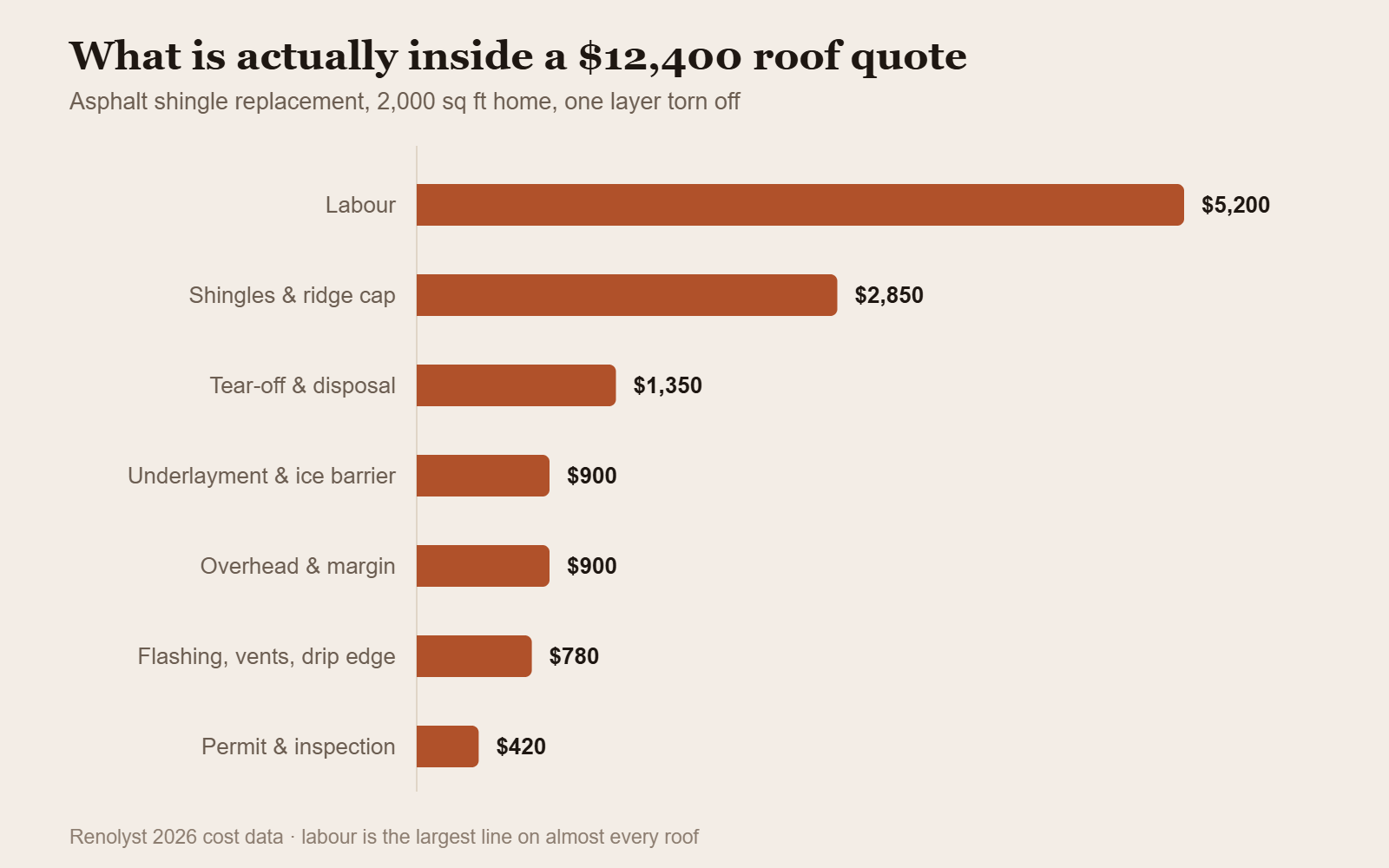
Here is a typical $12,400 asphalt job on a 2,000 sq ft house, broken into the pieces a contractor is actually paying for:
| Line item | Typical cost | Share |
|---|---|---|
| Labour | $5,200 | 42% |
| Shingles and ridge cap | $2,850 | 23% |
| Tear-off and disposal | $1,350 | 11% |
| Underlayment and ice barrier | $900 | 7% |
| Flashing, vents, drip edge | $780 | 6% |
| Permit and inspection | $420 | 3% |
| Overhead and margin | $900 | 8% |
This is why “I found the shingles cheaper online” rarely saves much. Knock 20% off the shingle line and you have saved $570 on a $12,400 job — under 5% — while giving up the contractor’s warranty position with the manufacturer.
The extras that blow up the budget
Nobody quotes for these upfront, because nobody can see them until the old roof is off. Ask how each one will be priced before you sign, not after.
- Rotten decking — $70 to $120 per sheet of plywood, installed. On a roof that has been leaking quietly for two winters, six to twelve sheets is normal.
- A second layer to remove — adds roughly $1,000 to $2,000 in labour and dump fees on an average house.
- Steep pitch — anything above 7:12 needs staging and slows everyone down. Expect a 15% to 30% labour uplift.
- Chimney reflashing — $350 to $900. Skipping it is the single most common cause of a leak in a brand new roof.
- Ventilation correction — $400 to $1,200. Undersized venting is what cooked the last roof early.
- Skylight replacement — $900 to $2,500 each. Reusing a twenty-year-old skylight under a new roof is a false economy.
Gutters are the one extra worth planning rather than reacting to. The crew is already on the roof and the fascia is exposed, so replacing them during the roof job costs noticeably less than calling someone back later — see gutter replacement cost in 2026 for what it adds.
Replace, or repair for now?
A repair buys time honestly when the damage is local and the rest of the roof still has years in it — a few shingles off after a storm, one bad valley, flashing that has pulled away. That is a $400 to $1,500 conversation, and it is the right one.
Replacement is the honest answer when you see any of the following across the whole roof, not just in one spot:
- Granules filling the gutters every time it rains — the shingle surface is gone
- Shingles curling at the corners or lying flat and brittle
- Daylight visible through the roof boards from inside the attic
- Any sag along the ridge or between rafters
- Third repair in three years on the same slope
One more that people miss: if your roof is 18 years into a 20-year product and you are already planning to sell, replacing it usually returns more at closing than the discount a buyer will demand for a roof at end of life. Roofing is one of the few projects where the resale maths is genuinely favourable, similar to what we found with siding replacement.
How to read three quotes without getting lost
Get three. Then ignore the totals for a minute and compare these five things instead:
- Squares. If two roofers measured 24 and one measured 19, the cheap quote is not cheap — it is wrong, and you will get a change order.
- Decking allowance. A good quote states a per-sheet price and how many sheets are included. A quote that stays silent here is a quote with a hole in it.
- Underlayment. Synthetic or felt? Ice-and-water barrier in the valleys and along the eaves, or only at the eaves?
- Warranty, both halves. The manufacturer covers the shingle. The contractor covers the installation. Ask for the number of years on each — the second one is what actually protects you.
- Disposal and cleanup. Dumpster included? Magnetic sweep of the yard? Written, not implied.
If paying for it in one go is not realistic, roofing is one of the projects where financing genuinely makes sense — the alternative is water damage that costs more than the roof. We covered the options, rates and trade-offs in how to finance a renovation.
Common questions
How long does a roof replacement take?
An average asphalt roof is one to two days with a full crew. Metal and tile run three to five. Weather is the variable nobody controls — a crew will not open up a roof with rain forecast that afternoon.
Will insurance pay for it?
Insurance covers sudden damage — hail, wind, a fallen tree. It does not cover a roof that simply wore out, and most policies now depreciate older roofs heavily. Get your own inspection before you file, because a denied claim still sits on your record.
Can new shingles go over old ones?
Most codes allow two layers total. It saves around $1,200 in tear-off, and it costs you the chance to inspect the decking, adds weight, and traps heat that shortens the new roof’s life. It is a defensible choice on a rental you plan to sell. It is a poor one on a house you intend to keep.
Is there a best time of year to book?
Late winter and early spring. Crews are hungry, schedules are open, and you are not competing with everyone whose roof failed in the first big storm of autumn. The difference is typically 5% to 10%, plus a much shorter wait.
Keep reading
- Metal roof vs asphalt shingles: the cost comparison
- Siding replacement cost in 2026
- How to finance a renovation
If the roofer is already up there, get the chimney looked at too — chimney repair costs in 2026.
Fitting a skylight during a re-roof saves $500–$1,500 a unit. If you are re-roofing anyway, read skylight installation costs in 2026 before the shingles go back on.
Working out your own number? Our free renovation cost calculator gives you the range for your size and area in about ten seconds.
2 thoughts on “Roof Replacement Cost in 2026: Real Numbers by Size and Material”