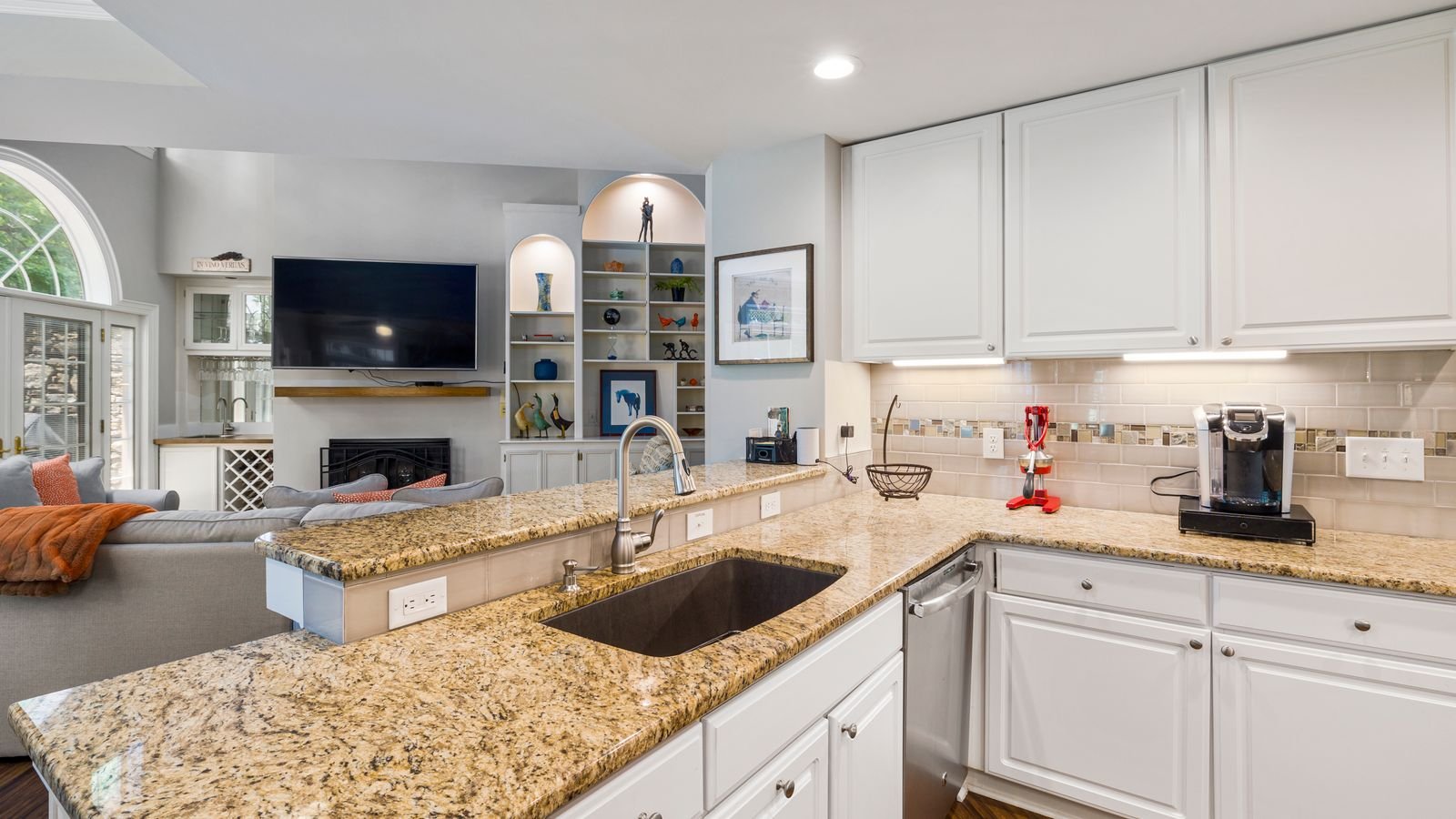
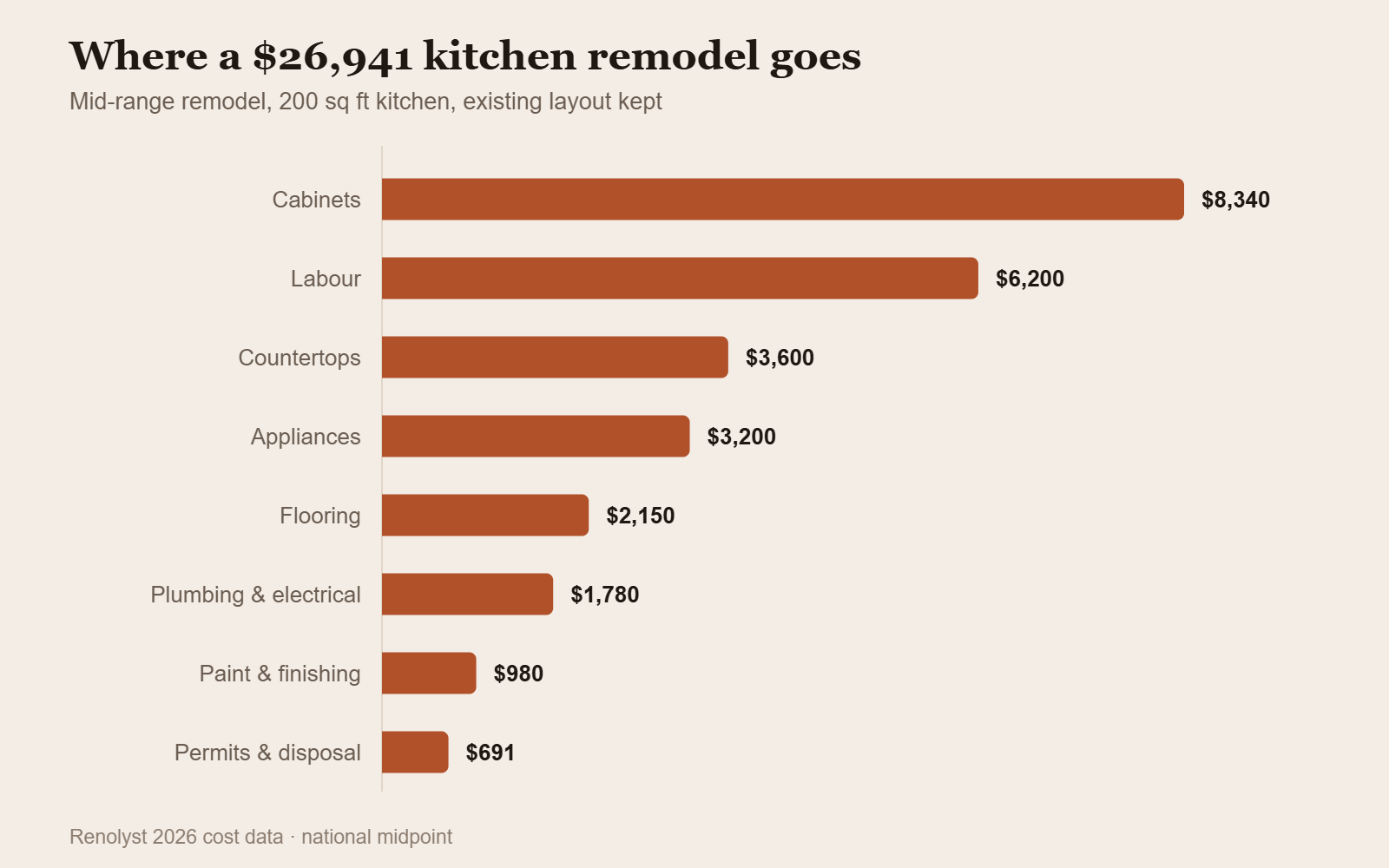
The number you want is $26,941. That is what the average American kitchen remodel ran in 2026, and most projects landed somewhere between $14,589 and $41,548.
Now forget that number for a minute, because it is close to useless on its own.
A $26,941 average blends a couple in Boise who repainted their cabinets and swapped a countertop with a family in Seattle who moved a load-bearing wall. Those are not the same project. The only figure that matters to you is the one that comes out of your scope, in your zip code, at your finish level — and that is what the rest of this guide is built to help you estimate.
What a kitchen remodel costs by scope
Scope is the single biggest lever on price. Bigger than granite versus quartz, bigger than which appliance brand you pick. Before you look at any other table on this page, find yourself in this one.
| Scope | Typical cost | What it usually includes |
|---|---|---|
| Minor / cosmetic | $10,000 – $20,000 | Cabinet refacing or painting, new countertops, backsplash, sink and faucet, paint. Layout untouched. |
| Major | $20,000 – $65,000 | New stock or semi-custom cabinets, new counters, new flooring, new appliances, updated lighting. Plumbing and gas stay roughly where they are. |
| Complete gut | $65,000 – $130,000+ | Walls move. Plumbing and electrical get rerouted. Custom cabinetry, structural work, sometimes windows. |
The jump from “major” to “complete” is where budgets die. Not because custom cabinets cost more — though they do — but because the moment a wall moves you have invited a structural engineer, a permit review, a plumber running new supply lines, and an electrician pulling new circuits into the same six-week window. Every one of those is a schedule dependency, and every schedule dependency is a place where money leaks.
If your layout basically works, keeping it is the cheapest good decision you will make all project.
Cost by kitchen size
Kitchens get priced per square foot more often than people expect, generally in the $75 to $250 range depending on finish level. Here is how that plays out across the sizes most homes actually have:
| Kitchen size | Budget finish | Mid-range | High end |
|---|---|---|---|
| 75 sq ft (small galley) | ~$5,600 | ~$11,000 | ~$17,500 |
| 100 sq ft (typical apartment) | ~$7,500 | ~$16,000 | ~$25,000 |
| 150 sq ft (average suburban) | ~$11,250 | ~$24,000 | ~$37,500 |
| 200 sq ft (large / open plan) | ~$15,000 | ~$32,000 | ~$50,000 |
One thing worth knowing before you use this table: square footage scales materials, not complexity. A 200 sq ft kitchen needs more cabinet boxes and more flooring than a 100 sq ft one, sure. But the plumber charges roughly the same to move a sink either way, and the permit fee does not care how big your room is. Small kitchens are therefore more expensive per square foot than large ones, which is why the low end of the 75 sq ft column feels stubbornly high.
Where the money actually goes
This is the part most cost guides skip, and it is the part that lets you negotiate.
| Line item | Typical range | Share of budget |
|---|---|---|
| Cabinets | $2,000 – $28,000 | ~40% |
| Labor | varies | ~25% |
| Countertops | $1,800 – $4,400 (premium $10,000+) | 8–15% |
| Flooring | $1,000 – $5,000 | 4–8% |
| Lighting | $500 – $2,000+ | 2–5% |
| Backsplash | $500 – $1,500 | 2–4% |
| Sink install | ~$420 | — |
| Faucet install | ~$260 | — |
| Repiping (if needed) | $1,500 – $15,000 (avg $7,500) | the wildcard |
Look at that first row again. Cabinets are close to half your budget. Which means every conversation about saving money in a kitchen is really a conversation about cabinets, and everything else is rounding error by comparison.
Cabinet hardware is its own strange category, spanning under $100 to well over $10,000 for the same number of knobs. It is the easiest place to quietly overspend, and one of the few line items you can change your mind about later without touching a tool.
The line item nobody budgets for
Repiping. That $1,500–$15,000 range, averaging around $7,500, is not a line on your original quote. It appears on day four, when the plumber opens the wall behind your sink and finds galvanized pipe from 1963.
If your house was built before roughly 1970 and has never had its supply lines touched, budget for this as a probability, not a possibility. Ten percent contingency is what contractors suggest. On an older home I would hold fifteen, and I would rather hand it back to you at the end than have you making a finish decision under financial pressure in week five.
Where you live changes everything
Regional spread on the same kitchen is enormous. The Mountain Prairie region runs roughly $6,000–$37,400. The Northwest runs $25,600–$61,100. Same cabinets, same counters, more than double the money.
That gap is almost entirely labor. Materials ship at similar prices nationwide; a licensed finish carpenter in Seattle does not cost what one costs in Omaha. So when you read a national average, mentally adjust it toward your own labor market before you get attached to it.
Will you get the money back?
Kitchen remodels return roughly 70% to 80% at resale, which is among the better returns in home improvement — and still a loss.
Say that plainly: spend $30,000, recover somewhere near $22,500. Nobody remodels a kitchen as an investment, and any contractor who pitches it that way is selling, not advising. You remodel a kitchen because you use it every single day and the current one makes you unhappy. The 75% return is what softens the decision, not what justifies it.
The exception is a kitchen so dated it is actively suppressing offers. Fixing a genuinely broken kitchen before listing is a different calculation, and there the math can work.
Five ways to cut cost without cutting quality
- Keep the layout. Every fixture that stays where it is saves plumbing or electrical labor. This is the biggest single saving available to you.
- Reface instead of replace. If your cabinet boxes are solid — open one and check the joints — refacing gets you a new kitchen face for a fraction of new cabinetry.
- Buy stock cabinets, spend on hardware. Good stock boxes with genuinely nice hardware read better than semi-custom boxes with builder-grade pulls.
- Skip the appliance upgrade cycle. If your range works, keep it one more year. Appliances are the easiest thing to swap later without touching anything else.
- Get three quotes, and read the exclusions. The cheapest bid is frequently the one that excluded demolition, disposal, and permits. Compare what is excluded, not what is included.
What a realistic timeline looks like
A cosmetic refresh runs two to three weeks. A major remodel is six to ten. A full gut with structural work is three to five months, and that assumes your permit office is not backed up.
Cabinets are usually the long pole — semi-custom orders commonly run eight to twelve weeks from order to delivery. Order them first. Order them before demolition. Contractors will tell you this and homeowners will ignore it, and then the kitchen sits gutted for six weeks waiting on boxes.
Frequently asked questions
What is the absolute minimum for a kitchen remodel?
Around $3,500 gets you paint, new hardware, a new faucet, and a laminate countertop in a small kitchen. It is a refresh, not a remodel, but it genuinely changes how a room feels and it is real money well spent if the bones are fine.
How much should I hold back as contingency?
Ten percent on a home built after 1990, fifteen on anything older. Kitchens hide more surprises than any other room because they concentrate plumbing, gas, electrical, and ventilation in one place.
Is quartz worth it over granite?
For most kitchens, yes — not because it looks better, but because it never needs sealing. Granite wants resealing every year or two, and the homeowners who love their granite are the ones who actually do it. Be honest about whether that is you.
Do I need a permit to remodel my kitchen?
If you are only changing surfaces, usually not. The moment you move plumbing, add circuits, or touch a wall, yes. Permits run $100 to $1,000 depending on jurisdiction, and skipping one becomes an expensive problem at closing when a buyer’s inspector notices unpermitted work.
Should I remodel the kitchen before selling?
Only if the current one is bad enough to lose you offers. A functional dated kitchen sells at a modest discount; a $40,000 remodel to recover $28,000 does not close that gap. Paint, hardware, and lighting are the pre-sale moves worth making.
How to use this guide
Pick your scope from the first table. Adjust for your size using the second. Sanity-check the split against the third, and add ten to fifteen percent on top. That number is what you should walk into contractor conversations holding — not as a budget you announce, but as a benchmark that tells you instantly whether a bid is reasonable.
Then get three quotes, and read every exclusion line.
These figures reflect national US data as of August 2026 and will drift with material and labor costs. If you have recent quotes from your own project, we would like to see them — send them through our contact page and we will fold them into the next update. More cost breakdowns are in our cost guides.
Get the numbers before you get the quote
New cost guides as we publish them, and revisions when material and labour prices move. No more than one email a week.
Related guides
- Quartz vs Granite Countertops: Cost, Upkeep and Which to Buy
- Cost to Convert a Garage Into a Room in 2026
- Cost to Convert a Tub to a Walk-In Shower in 2026
Related: Cabinet refacing vs replacing: what each really costs
Working out your own number? Our free renovation cost calculator gives you the range for your size and area in about ten seconds.
3 thoughts on “Kitchen Remodel Cost in 2026: What You’ll Actually Pay”