

On January 1, 2026, the federal residential solar tax credit went to zero.
Not phased down. Not reduced to 22%. Zero, overnight, with no transition period. If you buy a solar system with cash or a loan in 2026, the federal government contributes nothing toward it.
That is a 30% price increase on the same hardware, and it happened nine years earlier than the law it replaced had promised. So the question a lot of homeowners are asking right now is fair: does home solar still make sense?
The answer is genuinely “it depends on your state,” and this guide is about how to tell which side of that line you are on.
What actually happened
The Inflation Reduction Act had set the Section 25D residential credit at 30% through 2032, tapering through 2034. In July 2025 the One Big Beautiful Bill Act overrode that, ending the credit for customer-owned residential systems as of December 31, 2025.
Two things survived, and they matter:
- Systems installed before December 31, 2025 can still be claimed on a 2025 return, and unused credit rolls forward indefinitely.
- Third-party owned systems — leases and PPAs — still qualify under the commercial credit, Section 48E. Prepaid leases and PPAs qualify where construction begins before July 2026 or the system is in service by 2028.
That second point is the entire strategic picture for 2026, and we come back to it below.
What solar costs in 2026
| Figure | |
|---|---|
| Installed cost | $2.35 – $3.35 per watt |
| Typical system | 10 kW |
| Total, before state incentives | $23,500 – $33,500 |
| Federal credit | $0 |
| National average payback | ~9.4 years |
Under the old credit, that same $28,000 system cost $19,600 after tax time. The hardware did not get more expensive. The subsidy left.
Payback varies more than anything else about this decision
This table is the most useful thing on the page. Find your state, or the closest one to it.
| State | $/watt | System cost | Payback | 25-year savings |
|---|---|---|---|---|
| New Jersey | $2.81 | $37,757 | 6.4 yrs | $146,000 |
| Rhode Island | $2.91 | $33,200 | 7.3 yrs | $112,000 |
| Massachusetts | $3.16 | $33,631 | 7.7 yrs | $119,000 |
| Connecticut | $2.77 | $32,364 | 8.6 yrs | $105,000 |
| New Hampshire | $3.18 | $32,414 | 9.2 yrs | $97,000 |
| Maine | $2.91 | $33,581 | 9.4 yrs | $96,000 |
| Pennsylvania | $2.65 | $35,921 | 10.5 yrs | $82,000 |
| Vermont | $2.80 | $36,282 | 12.8 yrs | $67,000 |
| Texas | $2.20 | $38,640 | 13.1 yrs | $49,000 |
Look at the top and bottom rows carefully, because they overturn the intuition almost everyone has.
Texas has the cheapest installation in the table — $2.20 per watt — abundant sun, and the worst payback on the list at 13.1 years. New Jersey has pricier hardware, less sun, and pays back in 6.4 years.
Sunshine is not the variable. Policy is.
Why New Jersey beats Texas
Three things drive payback, and only one of them is weather.
State incentives. New Jersey’s SuSI program is worth around $13,500 over its term. Massachusetts SMART pays $8,000–$12,000 across ten years. Rhode Island layers a $0.35/W rebate onto its REG program for $6,000–$9,000. In states with programs like these, the state has effectively replaced the federal credit. In New Hampshire, the rebate is $500.
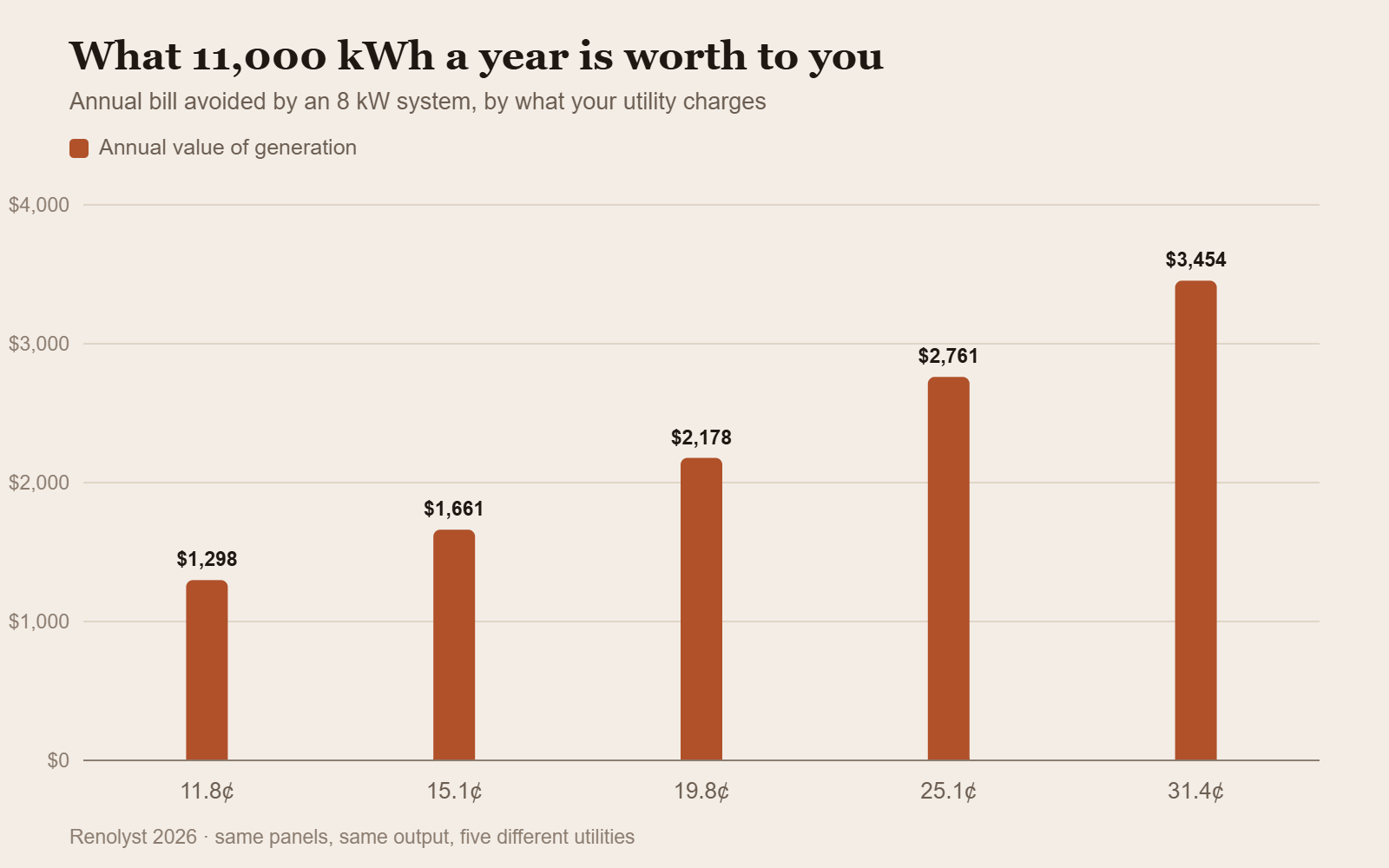
Electricity prices. Solar’s return is the utility rate you stop paying. Northeastern rates are roughly double Texas rates, so every kilowatt-hour a New Jersey panel produces is worth about twice what the same kilowatt-hour is worth in Houston.
Net metering. How your utility credits exported power — full retail rate, wholesale rate, or a fixed low tariff — can swing payback by years. This is the single detail most quotes gloss over, and the one worth reading your utility’s tariff sheet to confirm.
So is it worth it?
An honest sort:
Yes, clearly: strong state incentives, retail net metering, and high electricity rates. New Jersey, Massachusetts, Rhode Island, Connecticut. Payback under nine years on a system that runs 25 to 30 years means roughly two decades of free electricity. That still works, credit or no credit.
Probably, with care: moderate incentives, high rates, or planning to stay 15+ years. Payback of nine to twelve years is real but demands you actually stay to collect it.
Run the numbers hard: weak incentives, cheap electricity, uncertain tenure. Texas at 13.1 years and Vermont at 12.8 are not automatic noes — they are decisions that need your real usage, your real tariff, and an honest answer about how long you are staying.
Consider a lease or PPA instead: if you cannot use a tax credit anyway, or the cash purchase does not pencil, third-party ownership still captures the 30% commercial credit. The provider takes it and passes part of it through as a lower rate.
The lease question
Leases and PPAs have deserved their poor reputation. Escalator clauses that outpace utility rate inflation, twenty-year terms, and transfer friction when you sell — buyers have walked away from houses over assumable solar leases.
The arithmetic shifted in 2026, though, and it is worth being fair about that. A lease that captures a 30% credit you personally cannot access is a genuinely different proposition than a lease competing against a cash purchase that also got 30%.
If you go this route: refuse escalators above 2% annually, read the transfer clause before anything else, and get the buyout schedule in writing. The deal can be reasonable. The paperwork is where it goes wrong.
What is not in your quote
Roof condition. Panels last 25 to 30 years. If your roof has ten years left, you are paying to remove and reinstall an array mid-life — commonly $3,000 to $6,000. Do the roof first. Our roofing cost comparison covers the choice, and standing seam metal is the best surface to mount on because clamps attach to the seams without penetrating anything.
Panel degradation. Output falls roughly 0.5% per year. Twenty-five-year savings projections should already account for this. Ask whether yours does.
Inverter replacement. String inverters typically need replacing around year 12 to 15, at $1,500 to $3,000. Microinverters last longer and cost more upfront.
Batteries. A $10,000–$15,000 addition that rarely improves payback unless your utility has time-of-use rates with a steep peak spread, or your grid is genuinely unreliable. Buy a battery for resilience, not for return.
Frequently asked questions
Is the federal solar tax credit really gone?
For customer-owned residential systems, yes — it went to 0% on January 1, 2026 with no phase-down. Leases and PPAs still access the commercial 30% credit under Section 48E.
I installed in 2025 but have not filed. Can I still claim it?
Yes, if the system was placed in service by December 31, 2025. Claim it on your 2025 return, and unused credit carries forward indefinitely. Talk to a tax professional about your specific situation.
Will prices come down now that the subsidy is gone?
Somewhat, and it is already happening — demand fell and installers are competing harder on price. Do not expect a 30% drop. Installers have real labor and permitting costs that do not compress much.
Does solar increase home value?
Owned systems generally do, roughly in line with remaining savings value. Leased systems often do the opposite, because the buyer must qualify to assume the lease. This is the strongest practical argument for buying over leasing if you can.
How many quotes should I get?
At least three, and make them quote the same system size so the numbers are comparable. Ask each to show their production estimate and the assumed utility escalation rate — optimistic escalation assumptions are the most common way a payback figure gets quietly improved.
The bottom line
Solar in 2026 is a state-by-state question, not a national one. The federal credit is gone and it was doing real work. In states that stepped in with their own programs, the economics barely moved. In states that did not, payback stretched past a decade.
Find your state’s incentive programs, confirm your utility’s net metering terms, and be honest about how long you are staying. Those three answers decide it — not the sunshine.
Figures reflect US data as of August 2026. Incentive programs change frequently and this is not tax advice; confirm current terms with your state energy office and a tax professional before committing. More in our cost guides.
Get the numbers before you get the quote
New cost guides as we publish them, and revisions when material and labour prices move. No more than one email a week.
Related guides
- Quartz vs Granite Countertops: Cost, Upkeep and Which to Buy
- Cost to Convert a Garage Into a Room in 2026
- Cost to Convert a Tub to a Walk-In Shower in 2026
Related: Solar panel cost by state in 2026
Working out your own number? Our free renovation cost calculator gives you the range for your size and area in about ten seconds.
1 thought on “Is Home Solar Still Worth It in 2026? The Math After the Tax Credit Ended”