
Twelve thousand, one hundred and forty-seven dollars. That is the average American bathroom remodel in 2026.
It is also a number that describes almost nobody, because bathrooms have the widest cost spread of any room in the house. The realistic band runs from $2,500 to $30,000, and where you land inside it depends far less on taste than on one question: does the plumbing move?
This guide breaks down what each budget tier actually buys, why labor eats more of your bathroom budget than any other room, and where the money disappears if you are not watching.
What each budget tier really gets you
| Budget | Scope | What you get |
|---|---|---|
| $3,000 – $10,000 | Minor | New vanity, toilet, light fixture, paint, refinished or re-grouted tub. Everything stays where it is. |
| $10,000 – $25,000 | Partial | New tile floor and shower surround, new vanity and counter, new fixtures throughout, possibly a tub-to-shower conversion. |
| $25,000 – $80,000 | Full | Down to the studs. New layout, relocated plumbing, custom tile, frameless glass, heated floor, sometimes a wall moved. |
The gap between tier one and tier two is mostly tile labor. The gap between tier two and tier three is plumbing relocation, and it is brutal — moving a toilet three feet can add several thousand dollars, because the drain sits in the floor structure and the floor structure is not negotiable.
Cost by bathroom type
| Bathroom | Typical size | Cost range |
|---|---|---|
| Half bath / powder room | 15–25 sq ft | $1,500 – $15,000 |
| Guest / hall bath | ~80 sq ft | $5,600 – $20,000 |
| Primary bathroom | ~120 sq ft | $8,400 – $30,000 |
Across all three, the working figure is $70 to $250 per square foot.
Notice how wide the powder room range is. A half bath has no shower, no tub, and no waterproofing — so the low end is genuinely low. The high end is people putting a stone vessel sink and hand-painted wallpaper into a closet-sized room, which is a real thing homeowners do and enjoy. Small rooms are where expensive materials become affordable, because you need so little of them.
Labor is the story
In a kitchen, labor is about a quarter of the budget. In a bathroom it is 40% to 65%.
That is the single most important fact on this page, and it explains almost everything else about bathroom pricing.
Bathrooms are small, wet, and crowded with trades. A 40 square foot room needs a demolition crew, a plumber, an electrician, a tile setter, a glass installer, and a painter — and only one of them can work in there at a time. You are not paying for square footage. You are paying for six specialists to queue up outside a very small door.
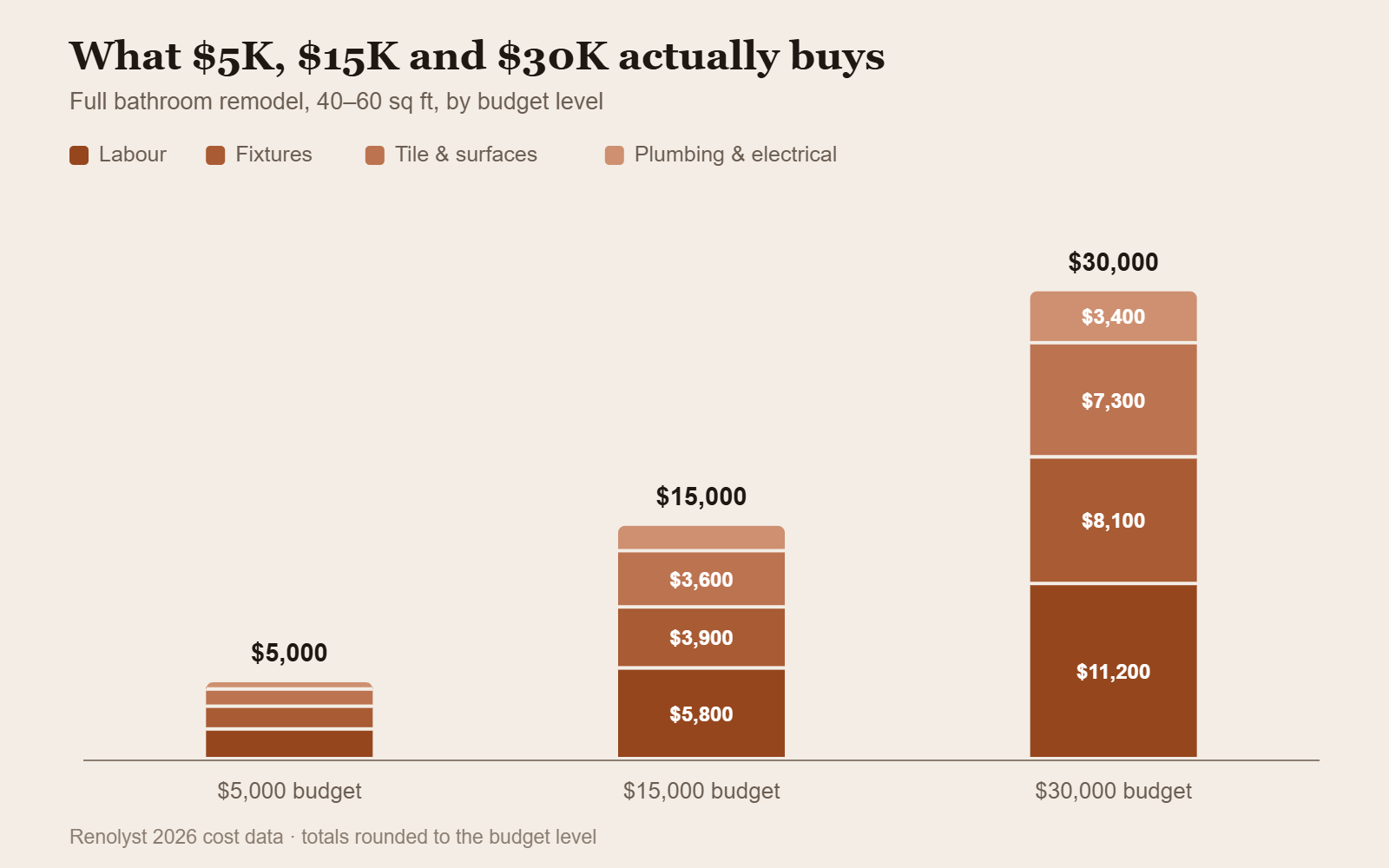
It also means the usual homeowner instinct — save money by choosing cheaper tile — barely moves the needle. Halving your tile budget on a $15,000 remodel saves maybe $600. Deciding not to move the shower saves $3,000.
Line-item costs
| Item | Cost |
|---|---|
| Shower installation | $300 – $15,000 (avg ~$8,200) |
| Bathtub replacement | $2,000 – $9,400 |
| Tile installation | $10 – $50 per sq ft |
| Flooring | ~$12.50 per sq ft |
| Countertops | $400 – $4,300 |
| Toilet installation | ~$375 |
| Sink installation | $250 – $675 |
| Faucets | $170 – $360 |
| Demolition | $1,000 – $2,300 |
| Permits | $100 – $1,000 |
That shower range — $300 to $15,000 — is not a typo, and it is worth understanding. Three hundred dollars is a fiberglass insert dropped into an existing alcove. Fifteen thousand is a custom tiled walk-in with a linear drain, a bench, niche lighting, and frameless glass. Same word on the invoice, entirely different projects.
The tub-to-shower question
Everybody asks this one, so here is the honest version.
Converting a tub to a walk-in shower typically costs $3,000 to $12,000 and returns about 60% at resale — noticeably worse than the 70% a full bathroom remodel returns. So on pure numbers, it loses.
But resale is the wrong lens for most people making this decision. If you are staying in the house and you have not taken a bath in four years, the tub is 30 square feet of floor space doing nothing. Convert it. If it is your home’s only tub and you might sell within five years, keep it — families with small children filter listings on that, and losing a buyer pool costs more than the shower is worth.
Where bathroom budgets break
Hidden water damage. Open a wall behind a thirty-year-old shower and there is a real chance of rotted subfloor or a compromised joist. This is the bathroom equivalent of the kitchen’s galvanized pipe. It is not on your quote and it will not be cheap.
Ventilation that was never adequate. Many older bathrooms have an undersized fan or none at all. Adding proper ventilation means an electrician and a roofer or siding cut. Skip it and you will be regrouting in five years.
Moving the toilet. Mentioned above, worth repeating. Everything else in a bathroom can be relocated with moderate effort. The toilet drain cannot.
Fifteen percent contingency is the floor for a bathroom, not the ceiling. This room hides more than any other.
Where to spend and where to save
Worth spending on: waterproofing behind the tile, the exhaust fan, and the shower valve. All three are buried in the wall. Replacing any of them later means demolishing finished work, so the cheap version costs you twice.
Worth saving on: the vanity, the mirror, the light fixture, and the toilet. Every one of these can be swapped in an afternoon years from now, by you, with a screwdriver.
That is the whole principle: spend on what is behind the wall, economize on what hangs in front of it.
Timeline
A cosmetic refresh is one to two weeks. A partial remodel is three to five. A full gut runs six to ten weeks, longer if custom glass is involved — frameless enclosures are measured only after tile is set, then fabricated, which reliably adds two to three weeks at the very end when you are already impatient.
If it is your only bathroom, plan where you are showering before demolition starts. People forget this every single time.
Frequently asked questions
Can I remodel a bathroom for $5,000?
Yes, if the layout stays put. New vanity, toilet, faucet, light, paint, and either refinishing the tub or replacing the surround. It will look like a different room. It will not be a gut renovation, and that is fine.
Why is bathroom labor so expensive relative to the room size?
Because six trades have to work sequentially in a space that fits one person. You are paying for coordination and mobilization, not floor area. It is the same reason a small kitchen costs more per square foot than a large one.
How much value does a bathroom remodel add?
About 70% of what you spend for a full remodel, 60% for a tub-to-shower conversion. Adding a bathroom where none existed — converting a closet into a powder room, for instance — performs better than upgrading an existing one, because it changes the bed/bath count that buyers search on.
Do I need a permit?
Surface work, generally no. Moving plumbing, adding circuits, or altering framing, yes. Expect $100 to $1,000. Unpermitted bathroom work is one of the more common things that surfaces during a sale and it is a poor time to discover it.
Should I do any of it myself?
Demolition and painting, yes — demolition alone can save $1,000 to $2,300 and requires more caution than skill. Waterproofing and the shower valve, no. Those are the two things where an amateur mistake stays hidden for two years and then costs five figures.
Putting a number on your project
Start with your bathroom type and its range. Ask yourself the one question that matters — is anything moving? — and if the answer is no, sit in the lower third of that range. If plumbing relocates, move to the upper third and add fifteen percent.
Then get three quotes and compare the exclusions, not the totals.
Figures reflect national US data as of August 2026. Renovation pricing moves; if you have a recent quote from your own project, send it via our contact page and we will factor it into the next revision. More breakdowns in our cost guides, including our 2026 kitchen remodel cost guide.
Get the numbers before you get the quote
New cost guides as we publish them, and revisions when material and labour prices move. No more than one email a week.
Related guides
- Quartz vs Granite Countertops: Cost, Upkeep and Which to Buy
- Cost to Convert a Garage Into a Room in 2026
- Cost to Convert a Tub to a Walk-In Shower in 2026
If the house still has galvanised supply lines, opening the bathroom walls is the moment to deal with them — whole-house repipe cost in 2026 explains what that adds.
Working out your own number? Our free renovation cost calculator gives you the range for your size and area in about ten seconds.