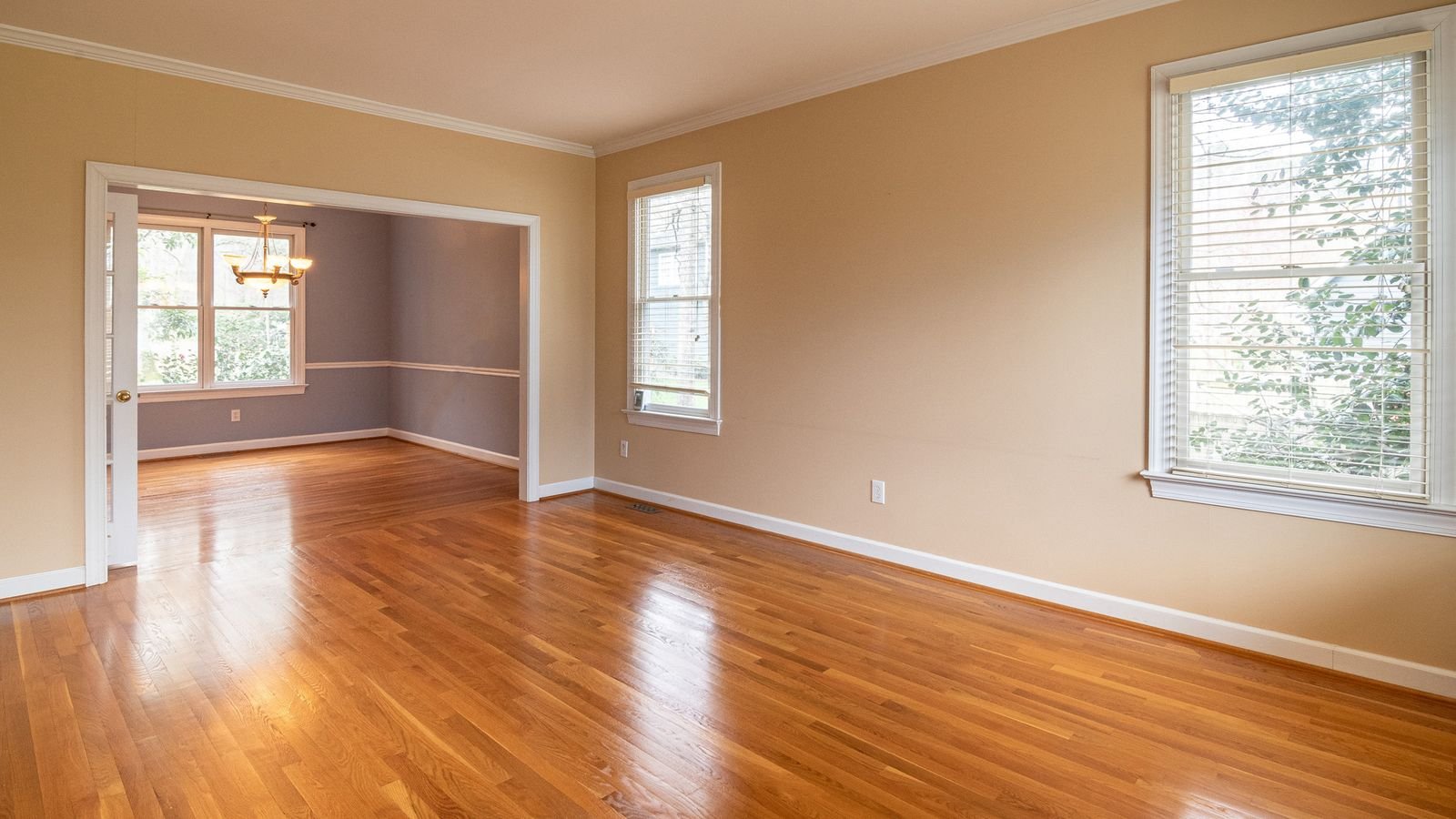
Refinishing is the rarest thing in renovation: a job where the cheap option is also the better one. Sanding back a tired oak floor and putting a new finish on it costs a fraction of replacement, keeps material out of a skip, and usually produces a floor that looks better than anything you could buy new.
The catch is that not every floor can take it, and the quotes vary enough that it pays to know what you are being charged for.
What refinishing costs in 2026
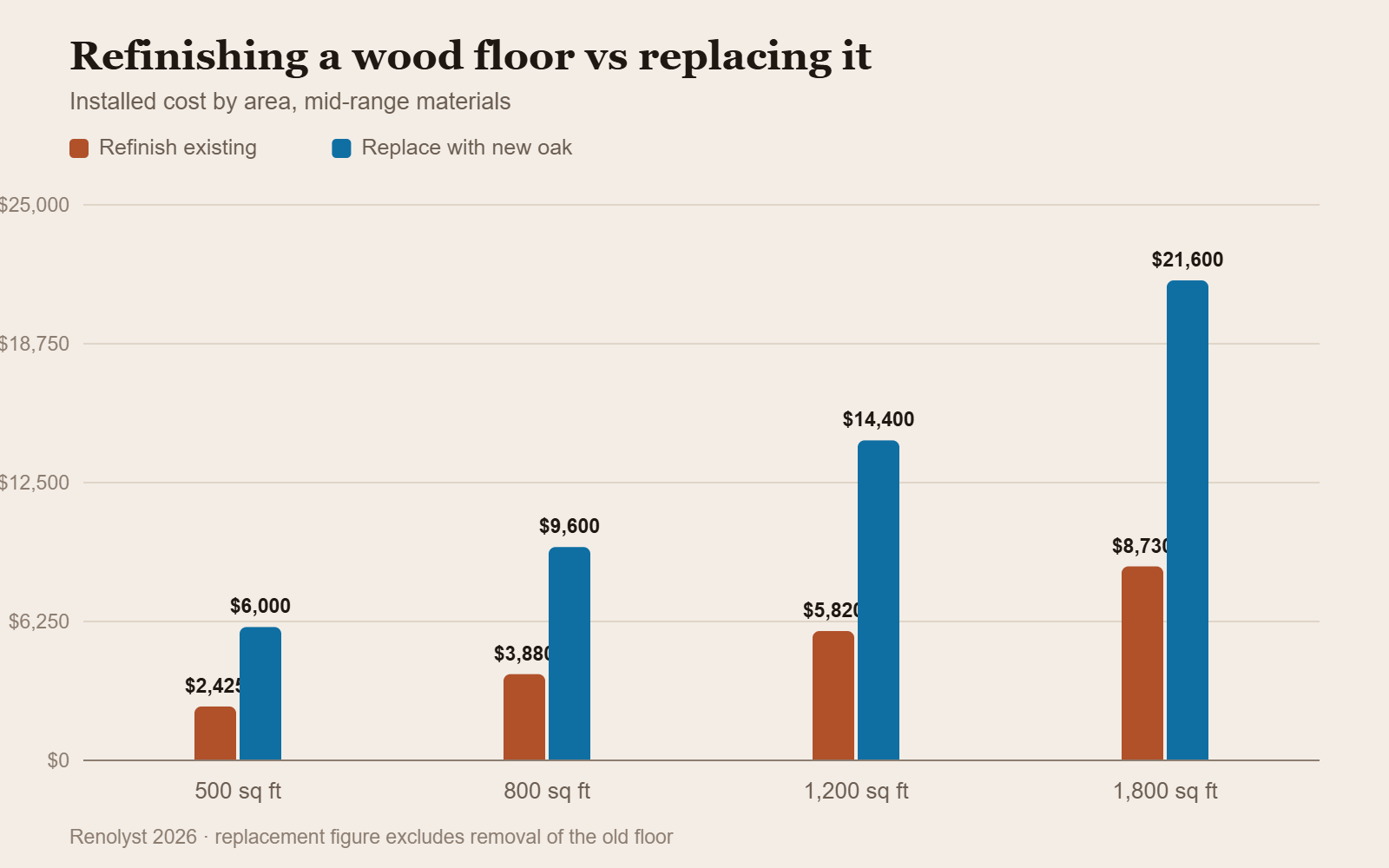
Most refinishing is priced per square foot of floor, and in 2026 the working range is $3.40 to $7.20 installed, with the national midpoint near $4.85. That covers sanding, staining if you want it, and three coats of finish.
| Area | Budget end | Typical | High end |
|---|---|---|---|
| 200 sq ft (one bedroom) | $680 | $970 | $1,440 |
| 500 sq ft (living + hall) | $1,700 | $2,425 | $3,600 |
| 800 sq ft (main floor) | $2,720 | $3,880 | $5,760 |
| 1,200 sq ft | $4,080 | $5,820 | $8,640 |
| 1,800 sq ft (whole house) | $6,120 | $8,730 | $12,960 |
Compare that to replacement. New solid oak installed runs $8 to $16 per square foot, engineered wood $6 to $13. On that 800 sq ft main floor, refinishing is around $3,900 against $7,200 to $12,800 to replace — and the replacement also means removing what is there, which is another $1 to $3 per foot.
Can your floor be refinished at all?
Sanding removes material. Every floor has a finite number of refinishes in it, and the answer depends on what is above the tongue.
| Floor type | Wear layer | Refinishes remaining |
|---|---|---|
| Solid hardwood, 3/4 inch | ~6 mm above tongue | 4 – 6 over its life |
| Engineered, 4 mm veneer | 4 mm | 2 – 3 |
| Engineered, 2 mm veneer | 2 mm | 1, carefully |
| Engineered, 0.6 mm veneer | 0.6 mm | 0 — screen and recoat only |
| Laminate or vinyl plank | Printed layer | Never |
Two quick checks. Pull up a floor vent and look at the cut edge of a board — you can see the layers directly. And look at the nose of the top stair: if the timber steps down at a doorway threshold, you can usually see the wear layer thickness there too.
If the floor is not solid wood at all, refinishing is off the table and the conversation becomes a replacement one. We compared the usual replacement candidates in vinyl plank vs laminate.
What drives the price up
- Stain colour change — adds $0.75 to $1.60 per sq ft. Going dark on red oak is the fiddliest version and needs a water-popped grain to look even.
- Pet stains — black marks are urine that reached the subfloor. Sanding will not remove them. Board replacement runs $12 to $30 per board plus blending.
- Old adhesive or paint — clogs belts and doubles sanding time. Common in houses where carpet was glued directly to the boards.
- Stairs — $45 to $95 per tread, hand-sanded. Fifteen stairs can add $1,000 to a $3,000 job.
- Gaps and cupping — filling is cheap; cupping caused by a moisture problem means fixing the cause first, or you will do this again in three years.
- Furniture handling — $200 to $600 if the crew has to move and store it.

Finishes, and how long they last
| Finish | Added cost / sq ft | Cure time | Recoat interval |
|---|---|---|---|
| Oil-based polyurethane | Baseline | 5 – 7 days | 7 – 10 yrs |
| Water-based polyurethane | +$0.60 – $1.20 | 2 – 3 days | 6 – 9 yrs |
| Moisture-cure urethane | +$1.10 – $2.00 | 3 – 5 days | 10 – 15 yrs |
| Hardwax oil | +$0.90 – $1.80 | 1 – 2 days | 3 – 5 yrs, spot repairable |
Hardwax oil deserves a mention for households with dogs. It wears rather than chips, and a scratched area can be cleaned and re-oiled in an afternoon without redoing the room. The trade-off is more frequent maintenance and a lower resistance to standing water.
Screen and recoat: the cheaper middle option
If the finish is dull and lightly scratched but no scratch has reached bare wood, you do not need a full sand. A screen and recoat abrades the existing finish and lays one new coat on top: $1.20 to $2.40 per square foot, one day, minimal dust.
The test is simple. Put a drop of water on a worn area. If it beads for a few minutes, the finish is intact and a recoat will work. If it soaks in and darkens the wood within a minute, the finish is gone in that spot and you need the full sand.
Done every six to eight years, a screen and recoat can keep a floor going almost indefinitely without ever spending its sanding allowance. It is the single most underused piece of floor maintenance there is.
Living through it
An 800 sq ft floor takes three to four days of work, plus cure time. With oil-based finish you are looking at roughly a week before furniture goes back, and two to four weeks before rugs — laying a rug on uncured polyurethane traps solvent and leaves a permanent outline.
Modern dust-containment sanders capture most of the dust, but not all. Seal doorways, take pictures off walls, and plan to be elsewhere for the sanding days if anyone in the house has asthma. Oil-based fumes are strong for 48 hours and genuinely unpleasant to sleep in.
Common questions
Can I refinish floors myself?
You can, and drum sander hire is around $80 to $140 a day. But a drum sander will gouge a floor in the second it takes to pause in one spot, and gouges are not fixable by sanding harder. If you try it, use a random-orbit floor sander instead — slower, far more forgiving, and the difference between a good result and a ruined floor.
Does refinishing add resale value?
It is one of the strongest returns in the house, largely because buyers read scuffed floors as neglect and read fresh ones as a maintained home. On a $4,000 refinish, most agents will tell you it comes back and then some at listing.
What about floors under carpet?
Often excellent — carpet protects wood. Expect tack strip holes around the perimeter, which disappear under skirting or fill easily, and occasional staple damage. Pull back a corner in a wardrobe before committing to anything.
Can only one room be done?
Yes, if there is a threshold to stop at. Matching a new finish to an adjacent old one is difficult — colour, sheen and ambering all differ — so a doorway makes a much better boundary than an open archway.
Keep reading
- Vinyl plank vs laminate flooring
- Vinyl plank flooring problems worth knowing
- Kitchen remodel cost in 2026
Working out your own number? Our free renovation cost calculator gives you the range for your size and area in about ten seconds.