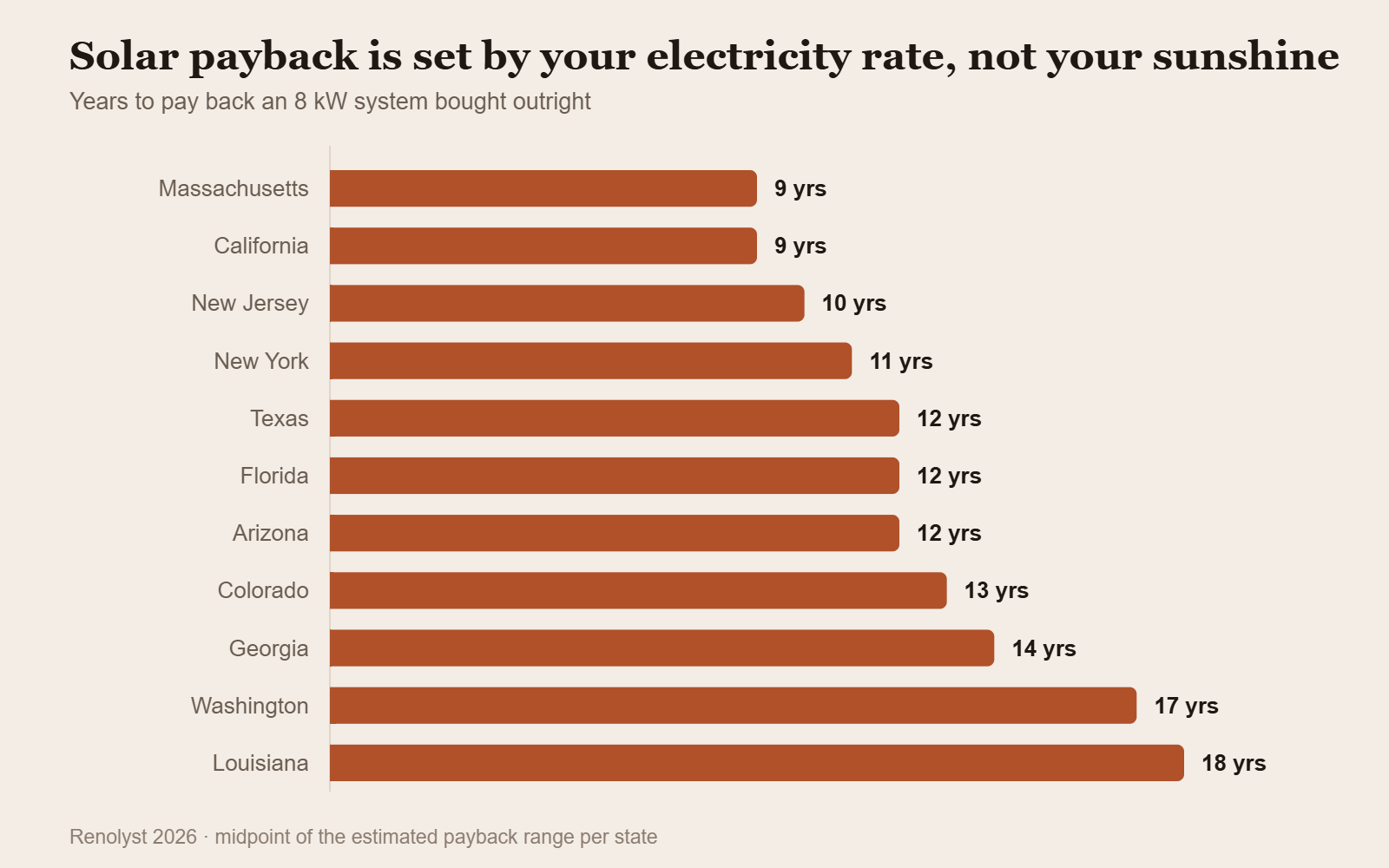
Every solar quote arrives with a national average attached to it, and the national average is close to useless. The same 8 kW system that pays for itself in nine years in Massachusetts takes nineteen in Louisiana — same panels, same installer margin, wildly different answer.
Three things drive that gap: what installers charge locally, what your utility charges per kilowatt-hour, and what your state does about net metering. Only the first appears on the quote.
What solar costs per watt in 2026
Residential solar is priced per watt of installed capacity before incentives. In 2026 the national band sits at $2.45 to $3.40 per watt, with the midpoint near $2.85. An 8 kW system — a common size for a household using around 950 kWh a month — therefore lands around $22,800 gross.
What moves that number locally is mostly labour, permitting and competition. Dense solar markets with many installers price lower. States with slow permitting offices price higher, because every extra week of waiting is carried cost.
Cost and payback by state
The table below shows the gross cost of an 8 kW system, the average residential electricity rate, and a rough simple payback period. Payback assumes you own the system outright and consume or export most of what you generate.
| State | Cost per watt | 8 kW system | Electricity rate | Rough payback |
|---|---|---|---|---|
| California | $2.95 | $23,600 | 31.4¢/kWh | 8 – 10 yrs |
| Massachusetts | $3.15 | $25,200 | 30.8¢/kWh | 8 – 10 yrs |
| New York | $3.05 | $24,400 | 25.1¢/kWh | 10 – 12 yrs |
| New Jersey | $2.90 | $23,200 | 19.8¢/kWh | 9 – 11 yrs |
| Arizona | $2.55 | $20,400 | 14.9¢/kWh | 11 – 13 yrs |
| Colorado | $2.75 | $22,000 | 15.2¢/kWh | 12 – 14 yrs |
| Texas | $2.50 | $20,000 | 15.6¢/kWh | 11 – 13 yrs |
| Florida | $2.45 | $19,600 | 15.1¢/kWh | 11 – 13 yrs |
| Illinois | $2.85 | $22,800 | 17.3¢/kWh | 12 – 14 yrs |
| Georgia | $2.60 | $20,800 | 14.2¢/kWh | 13 – 15 yrs |
| Washington | $2.70 | $21,600 | 11.8¢/kWh | 16 – 19 yrs |
| Louisiana | $2.60 | $20,800 | 12.1¢/kWh | 17 – 20 yrs |
Notice that Florida has among the cheapest installs in the country and still pays back slower than Massachusetts, where systems cost 29% more. Sunshine is not the variable that decides this. The electricity price you are avoiding is.
Why cheap power ruins the maths
Solar does not earn money. It avoids a bill. The value of every kilowatt-hour your roof makes is exactly what your utility would have charged you for it — so a household paying 31¢ is buying back three times the value per panel of a household paying 11¢.
An 8 kW system in a decent climate produces roughly 11,000 kWh a year. Here is what that same production is worth in different places:
| Utility rate | Annual value of 11,000 kWh | 25-year value (3% escalation) |
|---|---|---|
| 11.8¢ | $1,298 | $47,300 |
| 15.1¢ | $1,661 | $60,500 |
| 19.8¢ | $2,178 | $79,400 |
| 25.1¢ | $2,761 | $100,600 |
| 31.4¢ | $3,454 | $125,900 |
Net metering is the other half of the answer
Your panels make their most power at midday, when nobody is home. What happens to that surplus is set by state policy, and the difference between the good version and the bad version is worth more than any discount you will negotiate with an installer.
- Full retail net metering — every exported kilowatt-hour credits you at the same rate you pay. This is the best case and it is becoming rarer.
- Net billing at avoided cost — exports credit at wholesale value, often 3¢ to 6¢ against a 20¢ retail rate. Payback stretches by years.
- Time-of-use export rates — midday exports are worth least, evening usage costs most. This is the arrangement that makes a battery genuinely pay rather than being a nice-to-have.
- No mandated export compensation — a handful of markets. Self-consumption is the only value, and a battery stops being optional.
Ask any installer one specific question: what is my utility’s current export rate, and how long is it locked for? A vague answer is a red flag. Many states grandfather existing customers onto the terms in force at interconnection, which means the policy on the day you switch on matters for the next twenty years.
What a quote should break down into
| Component | Share of an 8 kW quote | Typical amount |
|---|---|---|
| Panels | 26% | $5,900 |
| Inverter or microinverters | 13% | $3,000 |
| Racking and mounting | 9% | $2,050 |
| Electrical, wiring, disconnects | 8% | $1,800 |
| Labour | 17% | $3,900 |
| Permits, inspection, interconnection | 7% | $1,600 |
| Sales, design, overhead, margin | 20% | $4,550 |
Get three quotes and compare cost per watt, not total price. A $19,000 quote for 6 kW is worse value than a $23,000 quote for 8 kW, and the shape of the sales conversation will try hard to stop you noticing.

Things that quietly add cost
- An electrical panel upgrade — $1,800 to $4,000 if your service is 100 A or the busbar cannot take the backfeed.
- Roof age — putting panels on a roof with six years left means paying $1,500 to $4,000 to remove and reset them later. Do the roof first. Our roof replacement cost guide has the numbers.
- Ground mount instead of roof — adds $0.35 to $0.70 per watt for trenching and footings.
- Battery storage — $9,000 to $16,000 installed for 10 to 13 kWh. Worth it under time-of-use or poor export rates; hard to justify under full retail net metering.
- Tree removal — $600 to $2,500 per tree, and a shaded string can cost you a fifth of annual output.
Common questions
How do I size a system for my house?
Take twelve months of bills, add up the kilowatt-hours, and divide by the annual production per kW in your area — roughly 1,200 to 1,600 kWh per kW installed depending on climate and orientation. Aim to cover 80% to 100% of usage; oversizing beyond your consumption only pays if your export rate is generous.
Does solar add to the home’s value?
Owned systems generally do, and appraisers increasingly account for them. Leased systems and power purchase agreements often do the opposite, because the buyer inherits a contract. If resale within ten years is plausible, ownership matters more than the monthly saving.
How long do panels last?
Panels carry 25-year performance warranties and typically still produce 85% to 90% of rated output at that point. Inverters are the weak link — string inverters usually need replacing once at year 12 to 15, at $1,500 to $3,000. Microinverters often carry 25-year warranties instead.
Is it still worth it without a federal credit?
In high-rate states, yes — the payback lengthens by roughly two to three years but stays inside the system’s life. In low-rate states it is genuinely marginal, and honest installers there will tell you so. We went through that change in detail in is solar worth it in 2026.
Keep reading
On rural land, water is the other big utility question. Here is what drilling a well costs in 2026.
Working out your own number? Our free renovation cost calculator gives you the range for your size and area in about ten seconds.
1 thought on “Solar Panel Cost by State in 2026: Where It Pays Back and Where It Does Not”