You have equity in the house and a kitchen that needs $40,000 spent on it. Your bank will happily lend against that equity in two different shapes, and the names are close enough that most people pick whichever one the loan officer mentioned first.
They are not interchangeable. One is a fixed lump sum. The other is a credit line you draw from as the work happens. Which one costs you less depends almost entirely on the shape of your project — not on which has the better advertised rate.
The difference in one paragraph
A home equity loan hands you the full amount on day one at a fixed rate, and you repay it in identical monthly instalments for the whole term. A HELOC approves you for a limit, then lets you draw what you need during a draw period — usually ten years — paying interest only on what you have actually taken, at a rate that moves with the market.
Both are secured against your home. That is the part worth sitting with: this is not credit card debt. If the payments stop, the asset at risk is the house.

Side by side
| Home equity loan | HELOC | |
|---|---|---|
| How you get the money | One lump sum at closing | Draw as needed for ~10 years |
| Rate | Fixed for the term | Variable, tied to prime |
| Typical rate in 2026 | 7.9% – 9.6% | 7.4% – 10.2% |
| Term | 5 – 30 years | 10-year draw + 20-year repay |
| Interest charged on | Full balance from day one | Only what you have drawn |
| Monthly payment | Same every month | Changes with balance and rate |
| Closing costs | 2% – 5% of the loan | Often $0 – $500 |
| Best fitted to | One project, known price | Phased work, unknown final cost |
What each one actually costs
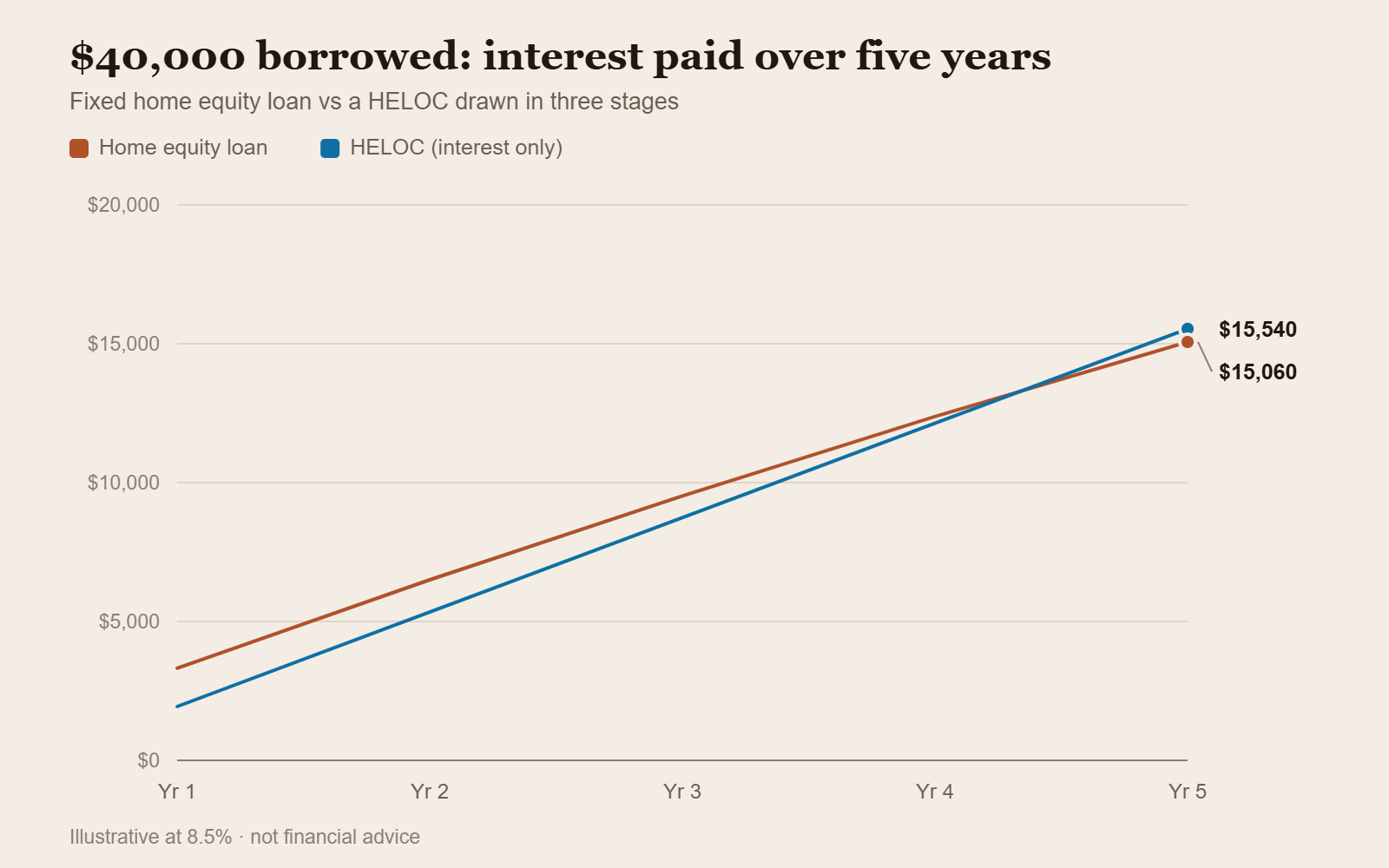
Take the same $40,000 kitchen. Here is how the two products behave over the first five years, assuming an 8.5% fixed loan over 15 years and a HELOC that averages 8.5% but where you draw in three stages across eight months.
| Year | Equity loan — interest paid | HELOC — interest paid |
|---|---|---|
| Year 1 | $3,320 | $1,940 |
| Year 2 | $3,180 | $3,400 |
| Year 3 | $3,020 | $3,400 |
| Year 4 | $2,860 | $3,400 |
| Year 5 | $2,680 | $3,400 |
| Five-year total | $15,060 | $15,540 |
Two things fall out of that table. First, the HELOC’s advantage is front-loaded and modest — roughly $1,400 in the first year, which is real but smaller than most people assume. Second, if you only ever make the minimum interest-only payment, you arrive at the end of the draw period still owing the full $40,000, and the payment then jumps hard as principal kicks in.

Where the HELOC genuinely wins
- You do not know the final number. Whole-house work, or anything involving a 1960s bathroom, has a way of finding surprises. Borrowing $60,000 in a lump sum to be safe means paying interest on $20,000 you may never spend.
- The work is phased. Kitchen this spring, bathroom next winter. Draw twice, pay interest twice, on two smaller amounts.
- You will repay quickly. A bonus, a house sale, an inheritance already in motion — a HELOC has no prepayment penalty in most cases, and the low closing costs mean you have not sunk money into a loan you will retire in eighteen months.
- You want the line for later. Once the draw period is open, it is standing capacity for an emergency. That has value even unused — though it is also the trap, because standing capacity is easy to spend.
Where the fixed loan wins
- You have a signed contract with a fixed price. The amount is known, so the flexibility you would pay for with a HELOC has no value to you.
- A rising rate would hurt. A HELOC at 8.5% today can be 11% in three years. On $40,000 that is an extra $1,000 a year, arriving without warning.
- You want the debt gone on a schedule. Fixed instalments include principal from month one. There is a date on the calendar when you are finished, and nothing about your own discipline is required to reach it.
- Budgeting matters more than optimising. One number, every month, for the whole term. For a lot of households that is worth more than the theoretical few hundred dollars a HELOC might have saved.
What lenders will look at
Both products are underwritten on the same three things, and knowing the thresholds before you apply saves a hard credit pull on an application that was never going to clear.
| Factor | Usually needed | Best pricing at |
|---|---|---|
| Combined loan-to-value | 85% or below | Below 70% |
| Credit score | 620 – 660 minimum | 740 and above |
| Debt-to-income ratio | 43% or below | Below 36% |
| Equity after borrowing | 15% – 20% retained | 30% retained |
Combined loan-to-value is the one that surprises people. If the house appraises at $400,000 and the mortgage balance is $260,000, an 85% CLTV ceiling means total debt of $340,000 — so the most you can borrow is $80,000, not the $140,000 of equity you thought you had.
The costs nobody mentions on the phone
- Appraisal — $400 to $800, and it is on you even if the loan does not close.
- Annual fee on a HELOC — $50 to $100, charged whether you draw or not.
- Early closure fee — many HELOCs claw back waived closing costs if you close the line within three years.
- Inactivity fee — a handful of lenders charge for not drawing. Ask.
- Rate caps — read the lifetime cap on a HELOC. Some sit as high as 18%.
Both of these sit inside a wider set of options — cash-out refinancing, contractor financing, plain personal loans — and which family makes sense depends on your existing mortgage rate more than anything else. We laid that out in how to finance a renovation in 2026.
Common questions
Is the interest tax deductible?
In the US, interest on either product can be deductible when the money is used to buy, build or substantially improve the home securing the loan, within the usual limits. A new kitchen generally qualifies; consolidating credit cards does not. Rules change and thresholds vary — confirm with a tax professional rather than with a contractor.
Can I convert a HELOC to a fixed rate?
Many lenders offer a fixed-rate lock on part or all of the drawn balance, sometimes for a small fee. If you like the flexibility of a line but fear the rate, ask about this feature before you choose a lender — not every one has it.
How long does approval take?
Two to six weeks for either, with the appraisal usually the slowest link. Some lenders now use automated valuations on lower-risk files and close in under ten days.
Does either affect my existing mortgage?
No. Both sit behind your first mortgage as a second lien and leave its rate and term untouched. That is precisely why they appeal to anyone holding a mortgage at a rate far below today’s — a cash-out refinance would surrender it.
This article explains how these products work. It is not financial advice, and we are not licensed advisors — run your own numbers with a lender or an advisor before borrowing against your home.
Keep reading
Working out your own number? Our free renovation cost calculator gives you the range for your size and area in about ten seconds.
1 thought on “Home Equity Loan vs HELOC for a Renovation: Which Costs Less?”